Black Bunny: Evaluating a Modern Blackletter Font for Digital and Craft Design
In the diverse world of digital typography, the blackletter style presents a unique challenge and opportunity. Often associated with historical manuscripts and traditional branding, these fonts can feel antiquated or overly ornate. However, contemporary designers are increasingly seeking blackletter typefaces that blend historical gravitas with modern sensibilities. Black Bunny, a creation from Kong Font Studio, enters this space as a noteworthy option. This article provides a balanced examination of this font, exploring its characteristics, ideal applications, and how it stands within the broader category of blackletter and display fonts.
Understanding the Aesthetic and Design of Black Bunny
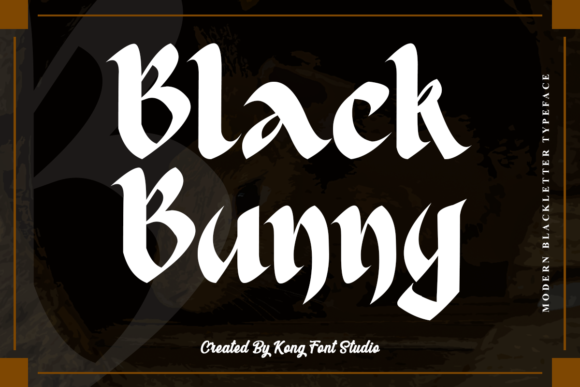
Black Bunny is explicitly described as a modern and cool blackletter font. This positioning is key. It aims to capture the intricate, angular, and often dramatic flair of traditional blackletter scripts—think Fraktur or Textura—while filtering it through a contemporary lens. The result is a typeface that likely features cleaner lines, more consistent spacing, and a stylized approach that avoids the dense, heavy complexity of its historical predecessors. Its intended audience—crafters and designers—suggests a focus on visual impact and versatility across various media rather than pure textual readability for long passages.
The font's compatibility with popular tools like Adobe Photoshop and Silhouette Design Studio is a significant practical detail. This indicates that Black Bunny is designed for integration into common creative workflows, whether for digital art, graphic design, or physical craft projects using cutting machines. For users of Silhouette's ecosystem, this compatibility can be a deciding factor, as font support and performance within that software are critical for achieving clean cuts and precise designs.
Black Bunny in Context: Comparing Styles and Categories
When evaluating a font like Black Bunny, it's helpful to consider where it sits on the typographic spectrum. It is not a text font meant for body copy; it is a display font designed for headlines, logos, titles, and short, impactful phrases. Its "blackletter" classification places it in a specific stylistic niche, but its "modern" descriptor suggests it may have simplified certain letterforms or incorporated subtle geometric influences to enhance its appeal for current design trends.
Compared to purely traditional blackletter fonts, Black Bunny might offer improved legibility at smaller sizes and a less intimidating, more approachable feel. Against other modern blackletter-inspired designs, its distinction would lie in the specific balance of its strokes, the degree of ornamentation, and its overall personality—whether it leans more towards edgy, elegant, or playful. The name "Black Bunny" itself evokes a blend of darkness (black) and a familiar, perhaps whimsical, creature (bunny), hinting at a font that doesn't take itself too seriously.
Practical Applications and Best-Fit Scenarios
The utility of a font like Black Bunny is highly context-dependent. Its strengths shine in specific scenarios where its unique aesthetic aligns with the project's goals.
- Branding and Logo Design: For brands seeking a distinctive, bold, and slightly unconventional identity—such as in music, streetwear, craft beverages, or artisanal goods—Black Bunny could provide a strong typographic voice. It conveys tradition with a modern twist, suitable for logos, merchandise, and packaging.
- Event and Editorial Design: Invitations for themed events, poster designs for concerts or festivals, and editorial layouts for magazines or blogs can benefit from the dramatic flair of a modern blackletter. It can set a powerful tone for a headline or a pull quote.
- Digital and Social Media Content: In the crowded digital landscape, a striking font helps content stand out. Black Bunny could be effective for YouTube thumbnails, Instagram graphics, or website hero text where immediate visual impact is crucial.
- Craft and DIY Projects: This is a core use case. For projects involving vinyl cutting, papercrafting, or heat transfers, a font that is both stylish and compatible with cutting software is essential. Black Bunny's compatibility with Silhouette Design Studio makes it a direct candidate for crafters creating custom decals, apparel, or home décor.
Tradeoffs and Considerations When Choosing Black Bunny
No font is universally perfect, and understanding the potential limitations of Black Bunny is part of making an informed decision.
- Readability vs. Style: The primary tradeoff with any blackletter font is legibility. While Black Bunny is marketed as modern, intricate letterforms can still be challenging to read quickly, especially at small sizes or in long strings of text. It is best reserved for short, key text elements where style trumps effortless readability.
- Context and Appropriateness: The blackletter style carries strong cultural and historical connotations. It is vital to consider the audience and the message. While a modern take like Black Bunny can mitigate some traditional associations, it may still evoke specific themes (e.g., gothic, medieval, rebellious) that must align with the brand or project's intent.
- Technical Performance: While compatibility is listed, the actual performance within design software—such as rendering speed, kerning accuracy, and the quality of the vector outlines when scaled—is something users may need to test. For crafters, the clarity of the font's paths is critical for clean cutting with minimal weeding.
- Comparison to Alternatives: The market for blackletter fonts is vast. Designers should compare Black Bunny not only to other modern blackletters but also to other bold, decorative display fonts that might achieve a similar visual weight and mood without the specific blackletter style. The decision often comes down to the precise aesthetic nuance required.
Is Black Bunny the Right Choice for Your Project?
Determining if Black Bunny fits your needs involves a straightforward evaluation of your project requirements against its offered features.
Black Bunny may be an excellent choice if:
- You are specifically seeking a blackletter style with a contemporary edge.
- Your project involves short, display-oriented text like headlines, logos, or titles.
- You work within the Adobe Creative Suite or Silhouette Design Studio ecosystems.
- Your target audience responds well to bold, stylized, and slightly edgy typography.
- You are a crafter looking for a visually interesting font that performs well in cutting software.
You may need to explore other options if:
- Your primary need is for highly legible body text or UI elements.
- The historical or cultural connotations of blackletter are a misfit for your brand's message.
- You require a font with an extensive family of weights and styles (Black Bunny is likely a single-weight display font).
- Your workflow relies on software not mentioned, where compatibility and performance would need verification.
Ultimately, Black Bunny presents itself as a specialized tool within the designer's toolkit. Its value is not in being an all-purpose solution, but in offering a distinct, modern interpretation of a classic style for specific creative applications. By carefully considering the project's context, audience, and technical requirements, designers and crafters can determine if its particular blend of tradition and modernity is the right fit to bring their vision to life. For those interested in exploring it further, examining its full character set and seeing real-world examples of its use would be the logical next step in the evaluation process.